« Frise test » : différence entre les versions
Aller à la navigation
Aller à la recherche
Aucun résumé des modifications |
Aucun résumé des modifications |
||
| Ligne 1 : | Ligne 1 : | ||
<timeline> | <timeline> | ||
ImageSize = width:555 height:555 | |||
DateFormat = YYYY | |||
Period = from:1864 till:1956 | |||
PlotArea = width:444 height:444 left:44 bottom:44 | |||
TimeAxis = orientation:vertical order:reverse | |||
ScaleMajor = unit:year increment:10 start:1864 | |||
ScaleMinor = unit:year increment:1 start:1864 | |||
PlotData= | |||
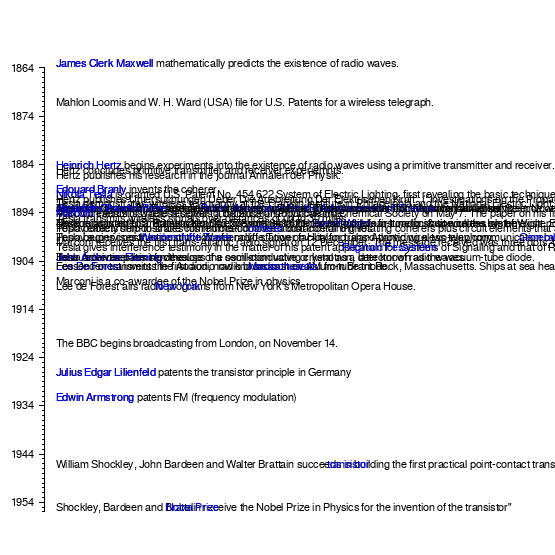
at:1864 text:"[[James Clerk Maxwell]] mathematically predicts the existence of radio waves." | |||
at:1872 text:"Mahlon Loomis and W. H. Ward (USA) file for U.S. Patents for a "wireless telegraph"." | |||
at:1885 text:"[[Heinrich Rudolf Hertz|Heinrich Hertz]] begins experiments into the existence of radio waves using a primitive transmitter and receiver. " | |||
at:1886 text:"Hertz concludes primitive transmitter and receiver experiemnts." | |||
at:1887 text:"Hertz publishes his research in the journal Annalen der Physik". | |||
at:1890 text:"[[Edouard Branly]] invents the [[coherer]]." | |||
at:1891 text:"[[Nikola Tesla]] is granted U.S. Patent No. 454,622 "System of Electric Lighting," first revealing the basic techniques for greatly improving radio transmitter performance." | |||
at:1892 text:"Hertz publishes "Untersuchungen Ueber Die Ausbreitung Der Elektrischen Kraft” (“Investigations on the Propagation of Electrical Energy”)." | |||
at:1893 text:"Tesla demonstrates "wireless telegraphy" at the Franklin Institute in Philadelphia and the National Electric Light Association, demonstrating the practical application eight years after Hertz experiments." | |||
at:1894 text:"The book 'Invention, Researches, and Writings of Nikola Tesla', edited by T.C. Martin is published." | |||
at:1894 text:"Hertz dies at age 37." | |||
at:1894 text:"[[Alexander Stepanovich Popov|Alexander Popov]] builds his first radio receiver in [[Russian Empire|Russia]]. This was the first non-laboratory radio service." | |||
at:1894 text:"Oliver Lodge transmits radio signals at a meeting of the [[British Association for the Advancement of Science]] at Oxford University on August 14. One year before Marconi but one year after Tesla." | |||
at:1894 text:[[Jagadish Chandra Bose]] uses electromagnetic waves to ignite gunpowder and ring a bell at a distance in November in [[Calcutta.]]"" | |||
at:1895 text:"Popov presents his radio receiver to the Russian Physical and Chemical Society on May 7. The paper on his findings was published December 15." | |||
at:1895 text:"[[Marconi]] transmits wireless signals a distance of about one mile." | |||
at:1896 text:"Tesla transmits wireless signals over distances of up to 30 miles." | |||
at:1897 text:"Tesla is granted U.S. Patents No. 645,576 and 649,621 covering the four-tuned circuit wireless system." | |||
at:1897 text:"Marconi is granted a British patent for his work, establishes the world's first radio station on the [[Isle of Wight]], England & forms the London company later to become the Marconi Wireless Telegraph Company" | |||
at:1897 text:"Bose reports on his microwave radio experiments to the Royal Institute in London & speculates on the existence of electromagnetic radiation from the sun." | |||
at:1898 text:"Popov effects ship-to-shore communication over a distance of 6 miles" | |||
at:1898 text:"Tesla publicly demonstrates his remote-controlled boat containing "rotating [[coherer]]s" plus circuit elements that allowed secure communication between transmitter and receiver." | |||
at:1900 text:"Popov supervises the construction of a radio station on Hogland island providing a two-way communication by wireless telegraphy between Russian navy base and crew of the battleship [[General-Admiral Apraksin]]. | |||
at:1900 text:"Tesla begins construction of the [[Wardenclyffe Tower]] facility for trans-Atlantic wireless telephony." | |||
at:1901 text:"Marconi receives the first trans-Atlantic radio signal on 12 December. The message received was three dots, the Morse code for the letter S." | |||
at:1902 text:"Tesla gives interference testimony in the matter of his patent application for "Systems of Signaling" and that of [[Reginald Fessenden]] for "Improvement in the Transmission and Receipt of Signals," subsequently determined in Tesla's favor." | |||
at:1904 text:"Bose receives patent for the use of a semi-conducting crystal as a detector of radio waves" | |||
at:1904 text:"[[John Ambrose Fleming]] develops the "oscillation valve" or "kenotron," later known as the vacuum-tube diode. " | |||
at:1904 text:"Tesla advertises his services." | |||
at:1906 text:"[[Lee De Forest]] invents the [[Audion tube|Audion]], now known as the vacuum-tube [[triode]]." | |||
at:1906 text:"Fessenden transmits the first audio radio broadcast on AM from Brant Rock, [[Massachusetts]]. Ships at sea heard a broadcast that included Fessenden playing the song Silent Night on the violin and reading a passage from the [[Bible]]. " | |||
at:1909 text:"Marconi is a co-awardee of the Nobel Prize in physics" | |||
at:1910 text:"Lee de Forest airs radio programs from [[New York]]'s [[Metropolitan Opera|Metropolitan Opera House]]. " | |||
at:1922 text:"The BBC begins broadcasting from London, on November 14." | |||
at:1928 text:"[[Julius Edgar Lilienfeld]] patents the transistor principle in Germany" | |||
at:1933 text:"[[Edwin Howard Armstrong|Edwin Armstrong]] patents FM ([[frequency modulation]])" | |||
at:1947 text:"William Shockley, John Bardeen and Walter Brattain succeeds in building the first practical point-contact [[transistor]] at [[Bell Labs]] on 22 December. This work followed from their war-time research into radar." | |||
at:1956 text:"Shockley, Bardeen and Brattain receive the [[Nobel Prize]] in Physics for the invention of the transistor"" | |||
</timeline> | </timeline> | ||
Version du 2 avril 2026 à 13:36